






























Background Music Strategy
5 Minute Read
Music Streaming Market Share 2026: Statistics and Trends
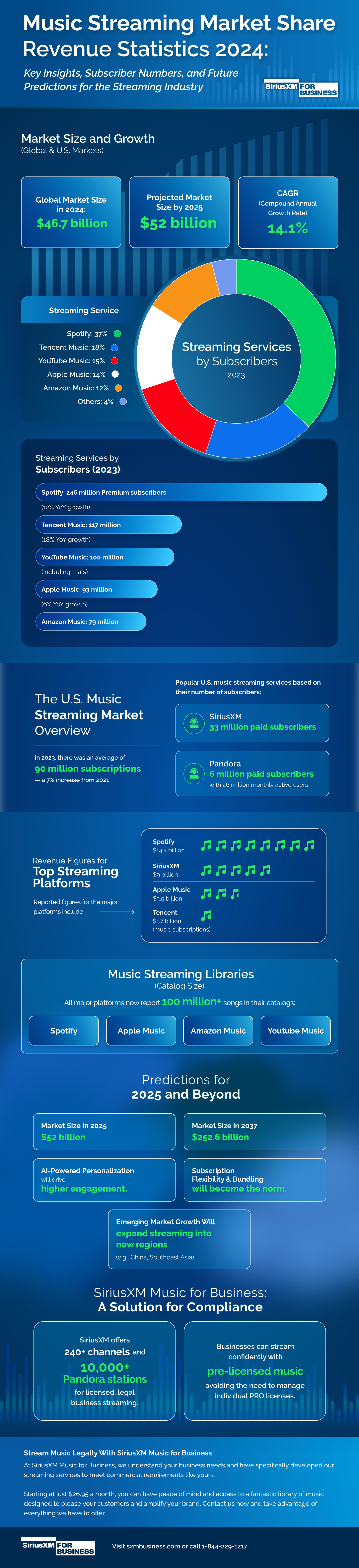
Music is no longer just background noise. It’s a business decision backed by billions of dollars in global revenue. In 2026, the music streaming market has grown into one of the most competitive industries on the planet, with hundreds of millions of paid subscribers and market share battles playing out across every device, vehicle, and commercial space. Here’s what the music streaming statistics look like.

Share This Infographic: Place the code below on your website.
Today’s Music Streaming Landscape
The global music streaming market has never been more competitive or more lucrative. The market reached $37 billion in 2025 and is projected to grow to $42.8 billion in 2026. That pace of growth reflects a fundamental shift in how the world consumes music: Physical media has given way entirely to on-demand, subscription-driven access.
The subscriber story is just as compelling. Streaming subscriptions surpassed 830 million globally for the first time in 2025, a milestone that underscores how firmly streaming has become the default mode of music consumption. Paid subscribers now account for 72% of global streaming revenue.
For business owners, these numbers tell an important story: Customers arrive at your door already accustomed to high-quality, curated listening experiences. The music in your space is measured against that standard every time someone walks through the door.
Why Music Matters
But how, when, and what businesses play make a difference.
Studies show music can significantly influence customers’ perceptions and behaviors. For example, a HUI Research study found that when restaurants play specially selected background music tailored to their customers’ demographics, they can increase revenue by over 9%.
Thoughtfully curated playlists, like those offered by SiriusXM for Business, directly impact a business’s financial success.

Streaming Services by Subscribers
Looking at raw paid subscriber counts adds important nuance to the market share picture. Spotify sits at the top with its 290 million subscribers, but other services are coming on strong:
- Tencent: 127.4 million
- YouTube Music: 125 million (including trials)
- Apple Music: 108 million
- Amazon Music: 80 million
These stats highlight the competitive landscape and the ongoing battle for listener loyalty among the most popular streaming services.
What’s Driving Music Streaming Market Growth?
Several forces are fueling the continued expansion of the streaming market. The shift away from ad-supported free tiers toward paid subscriptions is accelerating as platforms raise prices and improve their premium offerings. After years of anticipation, Spotify finally rolled out lossless streaming to its Premium subscribers in late 2025, putting it more on par with rivals like Apple Music, Amazon Music, and TIDAL that have offered lossless options for some time. Meanwhile, subscription price increases across all major platforms have lifted revenue.
The U.S. Music Streaming Market Share Landscape
The U.S. remains the world’s most valuable individual music streaming market, with 130 million paid subscribers.
SiriusXM is one of North America’s most important audio platforms for businesses. It reported Q1 2026 revenues of $2.1 billion with 33 million subscribers. The company’s strength in vehicles and commercial spaces gives it a distribution footprint that purely digital competitors haven’t matched. SiriusXM’s portfolio includes its flagship subscription entertainment service, the ad-supported and premium music streaming services of Pandora, an expansive podcast network, and a suite of business and advertising services.
Pandora continues to serve a large free-listening audience alongside its paid tier. Pandora Plus and Pandora Premium ended the first quarter of 2025 with 5.7 million self-pay subscribers.

Music Streaming Revenue Statistics

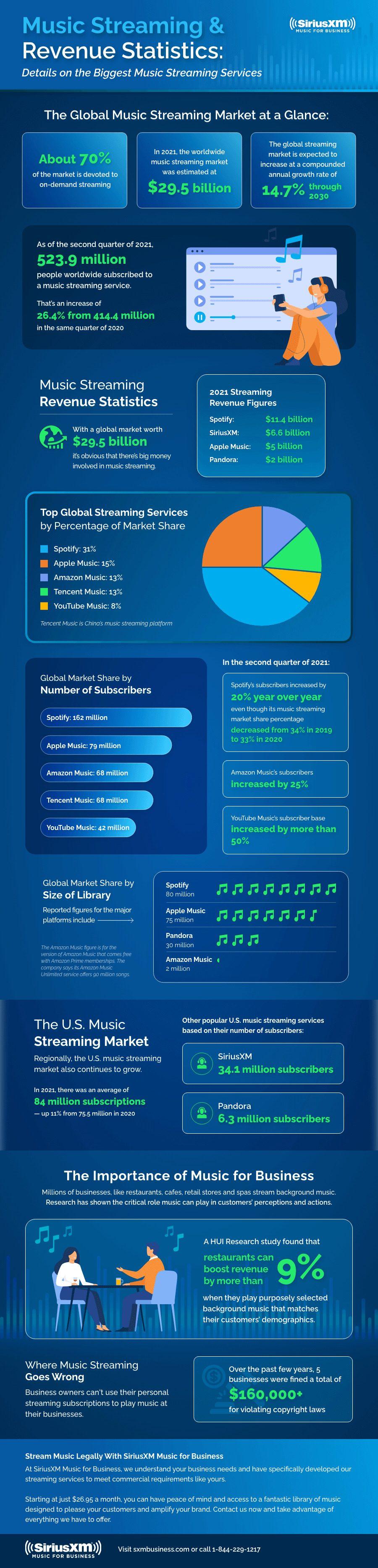
The global recorded music industry reached $31.7 billion in revenue in 2025, according to the IFPI’s Global Music Report 2026, with streaming accounting for roughly two-thirds of that total. Among individual platforms, the revenue figures reveal a highly concentrated market at the top:
- Spotify: $20 billion (2025)
- Apple Music: $9.2 billion (2023)
- SiriusXM: $8.6 billion (2025)
- Tencent: $1.2 billion (2025)
These figures underscore the sector’s high level of competition. The top platforms continue to invest heavily in AI-driven recommendations, original content, and audio-quality improvements to protect and grow their subscriber bases.
Music Streaming Libraries Continue To Grow
The number of songs in a music streaming service’s catalog is another way to measure its position in the marketplace. Services constantly add new tunes and musicians to their libraries. Four services all report having at least 100 million songs in their catalogs:
With each service constantly expanding its offerings, these vast libraries provide a competitive edge, helping platforms attract subscribers and maintain streaming service market share.
2026 Music Streaming Trends
Technology, shifting listener behavior, and the accelerating adoption of AI are reshaping the music streaming industry in 2026. Here are the four trends most relevant to businesses using music in their spaces.
1. AI-Driven Personalization Has Matured
AI recommendation engines have moved well beyond simple “listeners also liked” suggestions. In 2026, music apps now integrate conversational AI that allows users to interact naturally, asking for songs by mood, genre, or descriptions like “play something relaxing for studying.” This hands-free, intuitive experience makes music more accessible across devices. All four major platforms now rely on large language models to curate playlists, generate lyrics, and even suggest concert tickets. For businesses, this trend signals a rising customer expectation: music that feels intentionally chosen, not randomly shuffled.
2. Lossless Audio Has Gone Mainstream
High-fidelity streaming is no longer a niche audiophile feature. Spotify’s rollout of lossless streaming in late 2025 puts it more on par with competitors that have offered lossless options for some time. Audio quality has become a major differentiator in the competitive streaming market, and in 2026, apps increasingly offer immersive sound experiences that replicate live performances or studio environments. Customers with quality audio gear at home now notice the difference in commercial spaces.
3. Mood-Based Discovery Is Replacing Genre-Based Browsing
Throughout 2025 and into 2026, playlists on Spotify and other platforms began leaning heavily into emotional and mood-based concepts, with curators crafting collections that reflect specific feelings, moments, or states of mind rather than genres. This mirrors how businesses already think about background music, matching energy to customer experience.
4. Subscription Fatigue Is Real
With subscription fatigue on the rise and AI-driven personalization reshaping user experiences, understanding the nuances of each service is essential for enthusiasts, analysts, and anyone budgeting for entertainment. Price increases across Spotify, Apple Music, and Amazon Music in 2024 and 2025 have pushed some listeners to evaluate their options more critically. For businesses, this reinforces the value of a single, fully licensed commercial solution as the most cost-effective path forward.
Where Music Streaming Goes Wrong
While music streaming continues to redefine the music industry, it comes with specific challenges. A key issue for business owners is that personal streaming subscriptions can’t be used to play music in commercial settings. Using services like personal Spotify or Apple Music accounts for business purposes violates copyright laws.
The consequences of such infringements can be quite severe. In recent years, several businesses have faced hefty fines for these violations:
Apollo Global Management: In a high-profile case, Apollo faced a massive $264 million lawsuit for using personal streaming services without proper licensing to play music in the Venetian Hotel in Las Vegas in 2023.
Arizona Pub: BMI filed a lawsuit against an Arizona pub for playing six unlicensed songs, reinforcing how vigilant performing rights organizations (PROs) are about pursuing businesses that violate licensing agreements. Fines for such cases can range from $750 to $30,000 per song.
Other business music copyright cases include:
- Outback Saloon (Colorado): $40,000
- Roscoe’s (California): $36,000
- Foster’s (North Carolina): $30,450
- Tadpole’s (Florida): $30,000
ASCAP, a leading performing rights organization that monitors copyright compliance, reported filing lawsuits against 15 more businesses in June 2025 alone.
SiriusXM for Business: A Reasonable Alternative
With SiriusXM for Business, you won’t have to worry about copyright infringement. We handle all required licenses, so you can stream music confidently without legal risk.
Managing individual licenses across multiple PROs can be costly and complex. SiriusXM for Business simplifies this with over 240 channels and 10,000+ Pandora artist stations, offering a vast selection of fully licensed music for commercial use, including today’s top artists and genres. This means you can play music legally and affordably in your business without the hassle.
Music Streaming and Revenue Statistics Summary 2025
Share This Infographic: Place the code below on your website.
Take Advantage of the SiriusXM Difference
SiriusXM for Business gives you access to hundreds of professionally curated channels and more than 10,000 Pandora artist stations, all fully licensed for commercial play. At just $26.95 per month with no contract required, it’s the most straightforward path to legal, high-quality background music for your space. Talk to one of our experts today to find the right package for your business.
Frequently Asked Questions
Can businesses use YouTube Music or YouTube’s free tier for in-store music?
No. YouTube’s free tier and YouTube Music subscriptions, including YouTube Premium, are licensed for personal, noncommercial use only. YouTube’s terms of service explicitly prohibit public performance of content in commercial settings. Even though YouTube is effectively free to access, playing it for customers in a store, restaurant, or office constitutes a public performance under U.S. copyright law and requires a separate commercial license.
How do performing rights organizations know if my business is playing unlicensed music?
PROs like ASCAP and BMI employ field representatives who visit commercial establishments in person to check for unlicensed music use. They also receive tips from songwriters and publishers, monitor social media posts and venue listings that mention live music, and review advertising materials. A business doesn’t have to be large or high-profile to attract attention. PROs have filed suits against small bars with fewer than 100 seats. The fact that enforcement actions have continued uninterrupted through 2025 and into 2026 confirms these organizations actively prioritize compliance.
What happens to a business’s music license if a PRO’s catalog changes?
PRO catalogs change constantly as songwriters join, leave, or transfer their representation between organizations. A business licensed through a single PRO may find that songs it plays regularly are no longer covered if those songs’ rights holders switch organizations. This is one of the practical reasons many businesses choose a commercial streaming service like SiriusXM for Business: rather than tracking which PRO covers which songs and managing renewals with ASCAP, BMI, and SESAC separately, a single commercial subscription handles all public performance licensing in one place.
Related Articles: Music Streaming Market Share

Music Licensing for Business: The Ultimate Guide
Learn everything you need to know about licensing music for your business.

What’s the Most Affordable Streaming Service for Business?
Get an in-depth look at the costs involved wth music streaming.

Business Streaming Services Compared
Explore a head-to-head comparison of the top music streaming services for businesses.